Niche Talent Access

What we solve


🌀

Too much or too little interest

❌

Quality & conversions

✔️

Access to passive top performers

💞

GTM scalable processes

🎯

Reducing hiring risk


Our network
vs. Yours

Who you are working with


63k

Niche followers in network

30k

1st sales & founder connections

500+

Sales rep & exec testimonials

15k

Followers on IDR business page

Destiny herself does the majority of our recruiting and you'll never meet a candidate that Destiny has not fully vetted, “it’s a job I’ll do until I retire"

"I’m obsessed with building value within a niche community and love talking to fellow sales and operators about their proactive growth plans. I genuinely love this community & sales/startup game and spend 90+ hours a week networking with reps, executives and founders to align expectations & timeline with the best out there.”

- Destiny Brandt, Founder & Sales/Executive Recruiter


FREE to be intro'd to our center of influence


Believe it - you're already spending thousands on recruiting


The basics of our model

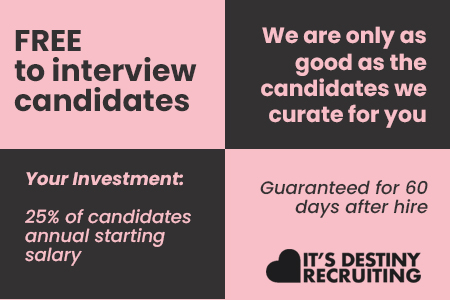
FREE

It is always free to interview our candidate referrals, you only make an investment if you choose to hire.

Candidates

We pride ourselves on our pool of passive top performing sales talent. We are only as good as the candidates we can curate for you!

Investment

Our fee is 25% of the candidates annual starting base salary.

Guarantee

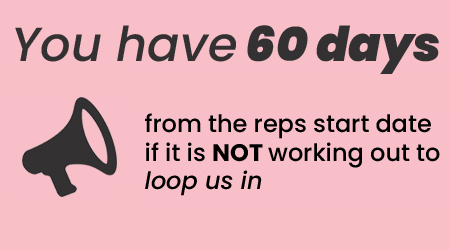
We guarantee our candidates will exceed expectations within 60 days after hire.


Working with us is risk-free, with huge ROI potential

It is always
FREE...
  • to review resumes

  • to interview our referrals

  • for us to do all the scheduling, candidate debriefing, securing the WIN

  • to engage in our services so we can be a walking talking billboard for you and attract the best of them
Our candidates
all come with...
  • a track record of $uccess selling into your buyer, at a similar stage of organization

  • a self-sourced lead list, and at least 5-step drip campaign/sales cadence - you know they understand who to sell into, and the problems your company solves before you even meet them
You only make the
investment when...
  • you know our candidate is better than anyone you can source on your own

  • you feel confident the rep will make you $$ and make you look good. With no pressure to hire right away, we keep talent engaged while you interview

  • you are certain our fee of 25% of their starting base annual salary will be just a fraction of the revenue they will generate for you

Niche Headhunter vs. External Recruiters

General External Recruiters
  • Typically lead with clients (b2b orgs)

  • They may have a sales counterpart, who is the one who builds relationships with hiring teams - sometimes (not always) can mean a game of "telephone" to get insights and there may be multiple parties "in between" you and the hiring leader

  • Your relationship with an external recruiter is dependent on if they have a job NOW and if they align closely with your niche (and you are "fee" worthy")

  • It can be extra hard to "sell" what makes a candidate special beyond a resume if you have multiple parties you have to "convince" to see your candidate
Niche Headhunters (IDR)
  • Lead with candidates
  • Spend a majority of our time networking and building relationships with passive, hard to land candidates
  • Build wish lists with these ideal candidates, if I am reaching out to you as a b2b founder or exec chances are my candidate gave me your name as a company to "sniff out" for them
  • Since we know what it takes to LAND a HOT candidate we often advise our b2b orgs on what they need to do to get access to YOU (a top rep or exec) increasing comp, payouts, title, benefits, travel accommodations, all the "little" things our candidates "demand" because they CAN
  • Most headhunters I know work with BOTH candidate and b2b employer
  • Build buy in with our orgs on WHY, FOR WHAT $/ WHEN, aligning timelines/req between all parties - proactively, while managing expectations -example when are you getting paid out commissions and when does it make sense to peruse an org at x start date)
  • Those who work on contingency (me) only get paid if our referral gets hired and are held to the "highest" expectations (anyone is regardless of title in this market) DEEP understanding of what works, what doesn't + what you can do to put your best foot forward
  • Work with b2b brands in the same niche (goal is to have multiple orgs that are EAGER to hire from a niche group of reps/execs) we have insights into product/competitor culture too if we aren't working with them - actively trying to pull out their teams (and hear/see proof a lot!)

We're able to do things your internal team can't


Interviews & Outreach

Internal
  • One and done interview process
  • Same candidate pool as us
  • The best candidates will apply on their own
It's Destiny Recruiting
  • We perform six interviews for one submittal
  • Our candidates are passive & wouldn't apply directly
  • Our search process is roactive in outreach
  • As a neutral 3rd party we can build pipeline from competitors
Admin

Internal
  • Deb from HR will have to get this done
  • If not HR, someone else within the organization will have to spend their time away from their main duties
It's Destiny Recruiting
We handle it all:
  • Scheduling
  • HR services
  • Helping build interview questions
Interview Prep

Internal
  • None/Some
It's Destiny Recruiting
We make sure:
  • They take it seriously
  • They will raise the bar
  • You don't waste time with losers
Interview Debrief

Internal
  • None/Some
It's Destiny Recruiting
We always:
  • Proactively understand candidate experience
  • Defend the deal for ideal candidates
  • Weed out people not taking it seriously
Weekly check-in

Internal
  • Just hope the hire will provide feedback directly
  • If they fail, it must just have not meant to be
It's Destiny Recruiting
Throughout the first 120 days we:
  • Collect feedback proactively
  • Ensure success and good fit
  • Focus on accountability
  • Provide insights
Ask questions like:
  • How are you doing?
  • What support do you need?
Future opportunities

Internal
  • The hire has been made
  • Back to your normal job, Deb!
It's Destiny Recruiting
  • Continue to build pipeline for forecasted roles

Why brands hesitate to use an external recruiter
(and why you shouldn't)

"We can hire internal & save $"
Reality
Time is money, leaving a sales role unfilled for months can cost thousands in lost revenue.
Solution
A $1M quota is ~$83k in missed revenue per month. We cut hiring & ROI time with top reps - our service is an investment, not an expense.
"Passive rep$ don't trust external teams"
Reality
GREAT sales reps are often skeptical of direct outreach from internal teams, assuming they’ll be “sold” on a role vs heard.
Solution
As a neutral 3rd party, we build trust by offering multiple opportunities & honest market/product/product positioning/sales org insights.
This allows us to uncover true motivations with brands & talent (where they’ll thrive/hit revenue goals) - giving our b2b clients access to talent they wouldn’t have engaged otherwise.
"Recruiters don't understand our biz"
Reality
Many recruiters lack niche expertise, but we specialize in Sales Recruiting (& GTM hiring for VC-backed SaaS startups or companies in “startup mode”)
We know what makes a top seller in these environments.
Solution
Our track record in sales hiring ensures we deliver reps who don’t just meet quotas but exceed them.
"External recruiters just throw resumes over"
Reality
Our niche, contingency headhunting biz depends on relationships and not wasting anyone’s time.
Solution
We pre-vet & deeply qualify sellers, ensuring every intro is a serious, committed, top-tier seller. Meeting most of our referrals 3+x before they meet you.
"We want to maintain full control"
Reality
Internal teams often struggle to engage passive talent, relying only on inbound applicants.
Solution
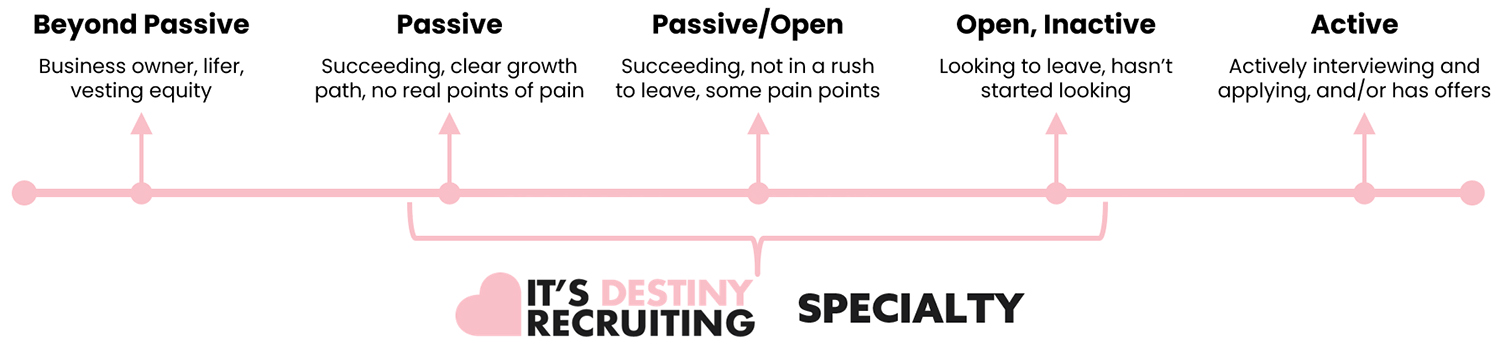
We reach candidates who aren’t actively job-seeking but are open to the right opportunity if we can meet their reqs and boundaries - talent you’d never see otherwise.
"We have job ads"
Reality
Postings attract active seekers, often not top sales talent.
Solution
Our network of 100K+ sales reps gives you access to proven revenue drivers.
"Our internal team can handle this"
Reality
Startup teams juggle multiple roles & expectations - tough to dedicate resources to build proactive value with top % sales reps.
Solution
We live & breathe sales hiring, ensuring founders and execs stay focused on growth while we deliver top players who are ignoring or not seeing your efforts.
"We'll just wait for the right seller/exec to engage"
Reality
Few are are giving you "30 minutes" to hear about an "exciting job".
Solution
We proactively headhunt with top performers, reducing time-to-fill by creating a "neutral" space for sellers + execs to talk about goals.
"Recruiters stink"
Reality
Our 300+ sales & exec recs provide social proof.
Solution
We prioritize our relationships with reps/execs, building connections with passive talent can take YEARS & the last thing we want is to ruin their trust (or yours) by making intros that do not stick.

Why top performing sellers and sales execs often ignore internal recruiting teams


Timing & Urgency
Internal recruiters are recruiting for a specific open role, often with urgency.

This can feel transactional, and passive candidates - especially high performers typically avoid conversations unless the timing is right for them.
Confidentiality
Responding to an internal recruiter or exec means engaging directly with a potential employer/competitor, which can raise concerns about confidentiality.

Third-party recruiters are viewed as neutral, making it easier for candidates to explore opportunities discreetly, without timelines or pressure.
Career Consulting vs. Job Pitching
Candidates are more likely to engage with third-party recruiters because the conversation isn’t always about a job right now.

It’s about building a long-term relationship, understanding the market, and knowing what’s next — when the time is right.
Credibility
Internal teams often don’t have the same depth of industry-specific knowledge as specialized sales and sales recruiters.

"If you are too close to it, you are too close."

Top salespeople are more inclined to speak with someone who understands sales, their market, quota pressure, compensation structure, and career trajectory (a benefit of working with a third party niche sales headhunter) who works ONLY with sales people and with similar orgs.
Limited Candidate Experience
Internal recruiters often manage large req loads and may not be able to offer a relationship first approach or give specific advice to sellers on how to put their best foot forward.

Third-party recruiters can provide more personalized guidance, market insight, and coaching, which sales candidates value.
ROI Calculator

3 facts about working with Destiny


Fact 1

We have access to, and will acquire better candidates

Fact 2

We know our referrals better than you ever will

Fact 3

We reduce risk within their first year & beyond


The biggest lie in sales hiring right now?

"There's so much talent out there"

No.

There is a lot of activity out there.
Funnel to acquire TOP talent

Our process
vs. Yours

How we know our talent


Relationships

Within community

Referrals

Placed Candidates

Referrals

Partnered with Leaders

Relationships

Long Term & New


Hiring Insurance

Most people wouldn't dream of not insuring a $50k car, yet they'll leave an $80k - $200k revenue-generating asset to chance.

We dig for the stuff that doesn't show up in interviews and disqualify early and often to reduce risk.

We act as an insurance policy - before, during, and after a hire is made.


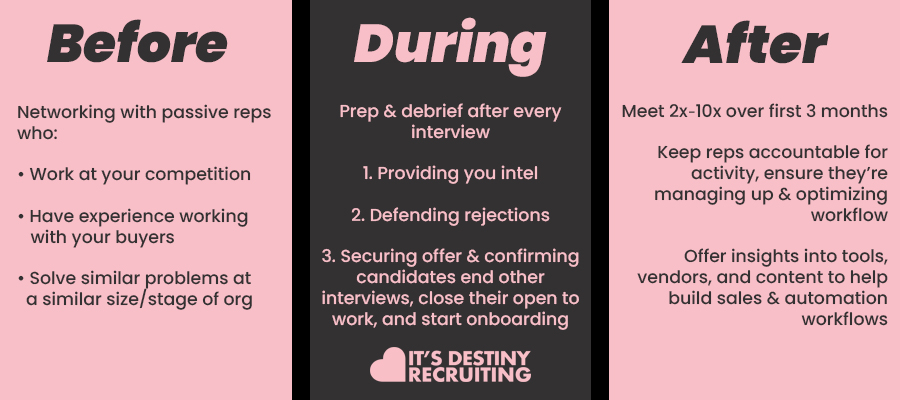
Our process focuses on making sure we do the work before, during, and after the hire


Before
We network with passive reps who:

  • Work at your competition

  • Have experience working with your buyers

  • Solve similar problems at a similar size & stage of org
During
We prep & debrief after every interview:

  • Providing you intel

  • Defending rejections

  • Securing the offer & confirming candidates end other interviews, close their open to work, and start onboarding
After
We meet 2x-10x over the first 90 days

  • Keeping reps accountable for activity, ensure that they're managing up & optimizing workflow

  • Offering insights into tools, vendors, and content to help build sales & automation workflows


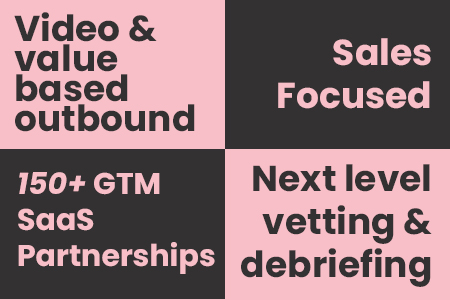
Here's how we're different from your normal "recruiter"

Outbound

Our outbound utilizes video tools with a value based approach to best be a walking, talking billboard for your company.

Sales

We specialize in sales talent and know exactly what to look for in a sales profile.

150+ Partnerships

GTM SaaS is our bread and butter, with experience in all stages of funding.

Vetting

We spend the time vetting & debriefing all of our candidate referrals to make sure they are qualified beyond what a resume might show.


  • We lead with candidates (Founding SDR/AE to Co-Founder/CSO)
  • GTM/Founding teams (seed - series b)
  • Representing passive sellers & execs at your competition (building org charts & creating pro active connections)
  • Only as good as the connections we make (reps we intro you to that convert to a successful hire)
  • Networking with sellers, sales execs & founders until the right partnerships align is ALL we do
  • Create lucrative and lasting partnerships (while aligning expectations and timelines)
  • NOT just sending you a resume - intro's we know WELL
  • Proactively building pipeline while you scale
  • 100+ reps, sales execs and founders in our center of influence


High expectations to ensure you're only ever meeting the best candidates


Most of our candidates we have met multiple times, since passive and performing sellers are more flexible on when, they just want to know where. They trust us to vet founders personality/process types and gigs on their behalf. We meet often, multiple times, and may be people who we have placed or represented in the past.

Step 1: Intro call, who are you outside of work, what are your goals, boundaries and how best to build a case for you
Step 2: Depending on timeline/urgency - in depth breakdown

  • Metrics, numbers, and conversions
  • Sales stories
  • Receipts
  • Homework


Expectations we have
  • Number$
    • Understand their numbers & conversions
  • Examples
    • Have examples of their wins, losses and lessons breaking down their (gtm sales) cycle
  • Proof
    • Have or can build proof of performance, linkedin recs, screenshots, receipts
  • Goals & Boundaries
    • Clear direction on what they want and what they want to avoid
  • Protect their Time
    • Understand where their time should go and how to get to goal
  • Startup Serious
    • Only considering startups, or changing environments where their experience and instincts will be valued
  • Design, Test, Perfect
    • Build data and systems, ask why, challenge, improve
  • Giant Nerds
    • Love learning, invest in themselves, record and improve everything
  • Show rather than tell
    • Write things down, build frameworks naturally, make it easy to understand concepts internally and externally
  • Curious, Gritty & Secure
    • Ask a lot of questions, push on the “why”, love the art and science of sales, secure enough to make it happen early, often and consistently
  • Willing to do the most, the build the most value (and get paid top $ for their efforts)

We focus on only the best of them


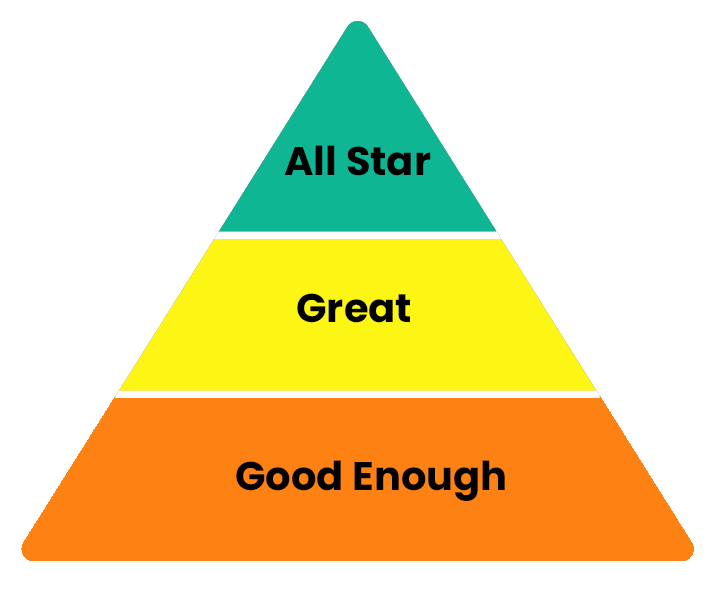
All Star Sellers
The best of the best:

  • Work at your competition and/or have experience working with your buyers
  • Startup, smaller org and/or GTM founding sales/exec experience
  • Proof of success
  • Have met 5x in the last year, some 20x+ and in person
  • Trust us to vett and curate jobs for them
  • Truly passive, or VERY intentionally interviewing
  • Sales psychopath
  • Potentially placed reps (we have referrals from their SVP/Founders, sales leaders)
Great Sellers
Better than most:

  • Recent experience with buyer and at a similar stage of org
  • Have met 1x-5x over time/this year - often more
  • Passive or active, performing
  • Not as many screenshots or social proof as an All Star Seller
  • Still a sales psychopath
  • Has references
  • Deeply vetted
  • Self assigned homework
Good Enough Sellers
They'll still impress:

  • Some experience with your buyer current/past
  • Experience in tech and SaaS
  • Startup or small environment sales experience
  • Provided stories/examples of how they can run the sales cycle
  • Still great reps, just not from an immediate competitor or exact buyer experience
  • Limited screenshots or "proof" of performance
  • Given a chance to complete self assigned homework

Our Process - Before


Building Buy In With Passive Performers


Our Process - Candidate Outbound
Passive recruiting is an art, that takes time.
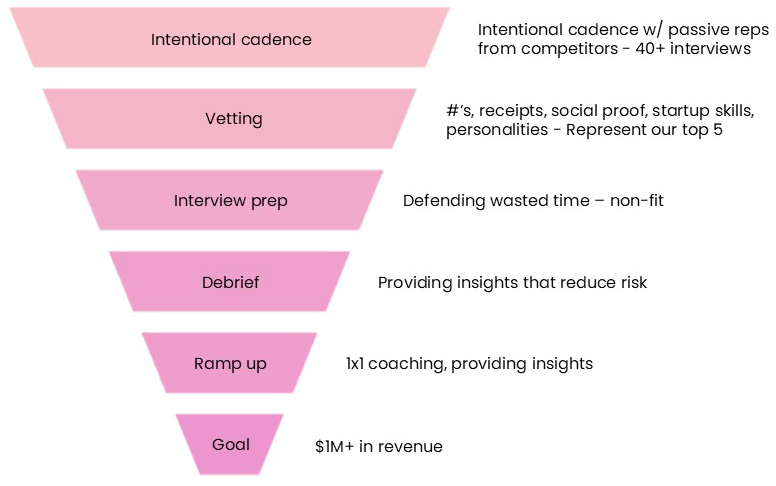
Relationships take work, we have an intentional, outbound cadence (no ai) where we teach, give & show and build genuine relationships based on personalization and relevance. Our messages actually get noticed by your ideal sales/ sales executive candidate

Our outbound notes aren't "hey I have a job" it's "Hey I can offer you x"

We give insights never listed/talked about early on in your “average” recruiter copy and paste. My messaging vs yours makes the difference in access (trust that I earn doing sales/sales executive recruiting 80+ hours a week vs another hat internal wears) After all, you can have the best offering in the world but if your message isn't compelling enough to earn an open/ meeting, it's almost like you don't exist at all

The info I am willing to offer and get is because of my in depth disco/challenger approach with the b2b orgs I represent and those insights and intentional follow consistent follow up are a game changer

I let candidates know early on where you are at in your sales org, what are the goals and what are the gaps - a great seller can smell BS a mile away and since we know the frustration of these profile types, we are honest, direct and can provide clarity quickly

Hard to acquire (passive) talent ignores your efforts (average me messaging w/ little intel beyond jd that is transactional (only for one op now) vs offering a long term relationship that is company and timeline agnostic (us). Even the most scrappy sellers/execs who can work with limited info want know what calls are worth their time & want insights + b2b/job vetting before taking meetings - we know what GREAT talent needs to know and offer it, candidly/up front and our messaging DOES convert.

All great relationship builders have an approach they utilize to stand out, make an impact and close the loop 🔁

For me personally and our team at It's Destiny Recruiting we spend just as much time (if not more) building value, trust and connection with candidates as we do b2b companies

We utilize videos, teach as much as we can about sales (podcasts, frameworks, content, books, events)

As a walking talking billboard for tons of b2b orgs we highlight specific to that company case studies, founder approach and personality indexes & anything and everything we have access to that goes beyond a job description

In between interviews and b2b discovery calls you will catch me cold calling, sending voice notes, engaging with your content & hitting you up on various channels (respectfully and with value based messaging)

As a creative seller I also dabble in a bunch of photoshop & writing personalized poems to my ideal partners - personalization always makes sense when the goal of the relationship is 5ever 💕

Goal is to:
Teach 🧠
Connect ❤️
Attract 🎯

People are BU$Y (especially a hot candidate with option$)

Since my relationship with candidates goes far beyond one job (goal is to bring value to them for the rest of their career)

I’ll do whatever it takes to get noticed, bring you value & offer connection when the time is right


Our Vetting - Acquiring the Best Talent
Passive recruiting is an art, that takes time.

Clients

✅ We are only as good at the candidates we can provide our clients
❌ One bad submission or interview and the trust can be broken

Candidates

✅ We are only as good at the jobs we can sell to our top performers
❌ Our job is to learn what makes you unique, and really SELL to your ideal candidate why making a move is worth it


Many of our candidate calls start with:


❌ I never respond to recruiters
✅ BUT (I liked your content, your approach)
❌ I haven’t considered leaving, I have been too busy
✅ BUT your message (video usually) was so unique I had to do the call

✅ We build relationships with top performers, so when they are ready to make a move, we are their first call *and we can make an intro*
A very proactive way of building relationships, versus the reactive way most run ads, and recruit for internal gigs

We build relationships with companies like yours, so when you need us, you can count on us, quickly. 🏋️


Our Vetting - Interviewing

Candidate interview agenda


Stage 1: Prospecting & Persistence

If I have not handpicked this rep to recruit for a specific opening now or in the future, they are expected to pursue me (you'll get a log of all of their outbound to warrant a call with me)

Sometimes, ill req active/more mid level reps to engage with me using their plays (w/qs, support, offer to help them with other interviews) have them (call, text, vm, email, dm) will they call and manage up - often will add proof to “show” founders rather than tell - ill tell them to call me 9x in a row to see who will follow directions

Stage 2: Communication & Proactiveness

Did they accept the calendar invite? Send a confirmation? Respond back to mine?

Not a deal breaker but talent who over communicates, shows an interest and does the little things with me typically especially after meeting, typically carry this into their roles.

Stage 3: Call Flow & Personality

How they open a call, types of questions they ask, how they help run the flow of the conversation.

How they communicate impact, goals, boundaries, opinions, roadblocks and how they set up themselves up for success.

What types of questions do they have for me?

What have they been through, what support/structure do they have to support constant growth?

Stage 4: Call Preperation & Learning

What did they do to prepare for the call with me? What types of research?

How do they learn? What was the last thing they learned?

What have they learned from their current/previous positions?

What type of accountability or lessons have come out of their experiences?

Stage 5: Numbers, Examples, Curiosity

Can they provide their numbers and sales process examples?

Can they give examples of deals they won, lost & lessons?

When asked an open-ended question: How do they answer, what types of examples do they give? Do they have proof to back up their claims?

Can they clearly and intentionally describe their sales process?

Fit & Timeline

Are they prepared and willing/excited to play to win in their next role?

Why now vs later in their search? Why a certain type of environment?

Red flags? Attitude, ego, interviewing for other gigs not in alignment (title, size)

Goals going forward? Personally and professionally? Roadblocks for getting there?


We know the importance of soft skills

Soft skills are the name of the game in sales recruiting, that is why we love supporting these teams and recruiting for these roles.
When it comes to soft skills, below are some of the most important things we look for in an ideal candidate:

  • Relationship skills
  • Trust building skills
  • Curiosity
  • Grit
  • Persuasive
  • Adaptability
  • Empathetic
  • Emotionally intelligent
  • Growth mindset
  • Hunger / drive
  • Storytelling
  • Strong communication and genuine rapport building
  • Active listening skills
  • Culture fit
  • Solutions oriented
  • Positive
  • Big picture mentality
  • Integrity


Our Vetting - Assigning Candidate Homework

Assigning homework to candidates

We get a lot of intel on the call on our candidates numbers, scenarios, intentions, positions and WHY.

We also ask them to provide “homework” to verify that the notes we took are accurate, to add anything we may have missed on a pretty conversational call and to help them build a case with companies/positions they are really excited about.


What assigning “admin” homework does to the vets:
  • Their follow up
  • Reconfirms their priorities
  • Provides them intel/advice on information they should have in their own tool kit (resumes, linkedin, their own interview pipeline)
  • Proves that someone knows how to follow instructions (easy to read, organized, correct format)
  • Helps “show” rather than “tell”
  • Interview prep homework will be assigned as well once you commit to seeing them, shows us how they prepare, how they follow instructions and how they will manage up/ the best way to support them throughout your recruiting life cycle - insights and resources they can use beyond a sales interview/ sales executive interview cycle with you - most people learn a thing or two from us and are thankful for our value based approach

Our Process - During


Organization and Top Candidate Prioritization


How we organize candidates (lists + scorecards)
Being intro’d to performers: Via email

Candidates will come with the following via email (and loaded into your ATS)

  • Resume
  • Linkedin URL
  • How many times we have met them (and length)
  • Have we placed them before in the past (and is our previous founder willing to recommend them)
  • Specifics line items based on intel we got from our discovery call with you
  • Their timeline to make a move and their availability to interview

  • Full metrics:
    • Activity
    • Conversions
    • ICP
    • Person and territory breakdown
  • Deal & Lesson Breakdown: Detailed examples of how they got to goal and how they will apply these methodologies in their next challenge
    • Deals they won
    • Deals they lost
    • How they won a deal from a competitor
    • Specifics of how they leaned on champions, got multiple stakeholders involved, their plays, their approach, their questions, how they tied insights together
  • Examples as it relates to startup themes:
    • Worked and won independently with limited resources
    • Converted free trials
    • Tested, designed and perfected sales plays and systems/ processes
  • Receipts: Great sellers have receipts or can easily obtain them
    • Written or video testimonials from their current/previous leaders, peers, teammates and clients
    • Dashboards, Awards, shout outs, earning proof
    • Willingness to give proactive reference intros for live conversations with a heads up
    • Templates, Resources, Frameworks designed by them (scripts, maps, contracts)
  • Self Assigned homework:
    • Quota math: Based on their outbound numbers, deal size and predictable conversions how would they need to organize their day for success in your org based on their assumptions?
    • Drip campaigns/outbound cadence: Specific to your buyer, or examples from current/past)
    • Buyer matrix: Personas they have or will sell into here, breakdown
    • Discovery questions Company and buyer agnostic to get a prsopect opening up and specific to this space, what they would ask to whom, how they refined need/use cases and what methodologies they are using
    • Presentation: How would they build a business case? From the past or what would they utilize here

    • Self assigned homework is not always required, just suggestions we offer if someone really wants to put their best foot forward to warrant a conversion and “show” rather than tell”.

      We make it clear there is NO guarantee this means an interview or hire, that this is something they must be willing to do to showcase without promises of time

We vet talent using a quantifiable, repeatable, bias-free method


We make sure candidates can prove how they have:
  • Made their company money

  • Saved their company money

  • Improved something while there


A repeatable & effective interview cycle


IDR Initial Meetings
Many of our reps we meet 1-3x before introducing a job opportunity
  • First call - meet Destiny - 45-60 min
  • Conversational call - goals, boundaries, metric examples - 1 hour
  • Opportunities - job intel, vet/sell opportunity - 30 min
Determine where the fall on the skill/talent matrix
Candidate Homework
After meeting with Destiny, candidates are assigned post-interview homework
IDR Continuous Involvement
Before, during, and after we will
  • Prep each candidate for 30-60 minutes ahead of time to make sure they aren’t wasting anyone’s time
  • Debrief after every interview
  • References
  • Partnering
    • If there are multiple hires in one class, or a leader/player coach combo, we will suggest who makes a great pair
  • Determine throughout guarantee they are not interviewing elsewhere, they are accountable for activity, and managing up
Interview Cycle: Founder Interview
Founder Interview
Interview Cycle: Executive Interview
Executive Interview
  • 45 minutes
  • 4 - 10 questions
  • Allow 15 - 20 minutes for candidate to ask questions
  • Homework - optional
  • Discover/Demo
Interview Cycle: Team Interview
Team Interview
  • Meet the team
  • 4 - 6 questions
  • Allow 20 minutes for candidate to ask questions
Interview Cycle: Founder/Exec Follow-up
Follow up meeting with founder or executive
  • Discuss comp plan
  • Verbal offer negotiation
  • Determine the level of autonomy you expect the rep to have, refine metrics, lead ownership, and payout terms
  • Contract/Comp


Our Vetting - Interview Prep - Reduce Time Wasted & Risk

Interview preperation - 30-90 minutes depending on role

Vet
  • Willingness to learn/ take coaching
  • Sense of urgency - Do they confirm right away/ priorities
  • Their level of commitment and communication - accepting invites, messaging back, proactive communication
  • How did they prepare
  • How much time did spend?
  • How will they structure their call?
  • What are they trying learn? Uncover? Validate? Challenge?
  • Is there interview approach the same or different than the sales cycle?
  • What did they learn that I did not include in my initial pitch of the job?
Intel
  • Mental and physical health
  • How was the last few days at work?
  • What's changed in their position (job, pipeline, priorities, positiony?
  • What roles, if any since we last spoke are they entertaining?
  • What stages they are at in a cycle? Where did they hear about this org? and how do these compare?
  • Timing for making a move? Changed since the last time we talked? If client has a start date in mind does that still work?
  • Roadblocks or concerns about this role? Company? Offerings? Comp? Quota?
  • Refining now vs later? If later based on what ? At what point are they going to bring this up? Do they want to or is this info they want me to share?
Goals
  • Make sure they are prepared
  • Confirm this is a priority
  • Reduce risk and roadblocks
  • Advocate for the candidate
  • Update our top referrals list as necessary
  • Learn more about the org via our candidates research & healthy skepticism

Making lasting & luctrative partnerships between sellers and orgs

We focus on making sure candidates & companies are fully aligned between:
  • Product

  • Buyer expertise

  • Stage of org

  • Sales methodology

  • Personality

  • Expectations

  • Vision & goals

  • Communication style

  • Collaboration style

  • Are actively interviewing with intentionality


Our Vetting - Interview Debrief - Reduce Time Wasted & Risk

The overlooked value of the interview debrief

Debriefing is an often overlooked part of the recruiting cycle. Some people either glance over this step or ignore it entirely. Or if an internal team is doing it, where the goal of the candidate is usually to get *hired* the info provided may not be entirely honest (or just what you want to hear)

When we employed sales recruiters internally, we let them know If you fail to complete this portion then you may as well not spend your time trying to find the candidates in the first place.

Because of these questions, we have a 100% close rate on legitimate offers delivered to our candidates.

In the debrief, we have two equally important goals
1. Gain Operational Intelligence
2. Secure the Candidate


Operational Intelligence is the background information we use to be successful with curating the right candidates and making sure the candidates who get to offer stage, will convert.

Hearing the candidate’s perspective on the company is highly illuminating and we use that to either target our search or explain to the client why this candidate is the best person to join their team.

By asking these questions we build a tighter relationship with our candidate referrals and help increase

This is not a 2-minute check and typically reserve as much time for this as we do an interview prep - 30-45 minutes, maybe longer for more critical hires like founding executive roles.

  1. How was your interview:
    • Did you like the person you were chatting with - can you see yourself working with them for the long haul?
    • What do you think of the company?
    • Are the products/services you’re going to be working with something you’d like to sell or work with for 2+ years?
    • D) Does this position sound like a good fit for your experience and what you’re looking to do next?
  2. Is there anything that stuck out about the interview?
  3. Anything that caught you by surprise?
  4. What is your favorite aspect of this company, team, or position?
  5. Are you more interested, less interested, or about the same?
  6. If the client calls us today asking for your feedback, what can I say to them?
  7. Can I expect you to loop me in with any and all information about your position/ feelings about this company/role as we get further in the process?
  8. Do you have any additional feedback we can provide to their internal teams about your candidacy? Anything we should know that would prevent you moving forward, or singing (and remaining loyal to this process) today?
  9. If extended an offer, would you accept? Would you accept at the base we sent you in at?
  10. Is there any reason that you would turn down an offer at the compensation level we submitted you at?
  11. What would it take for you to sign today, what would need to happen/ be answered for you to need 48-72 hours to “think it over” before you sign and commit?
  12. if you accept a verbal offer or sign a written offer today or by x, would you cancel your other interviews and accept it? If no, why not?
  13. If you accept a written offer, is there any reason that you would be unable to start within 2 weeks or by X start date?
  14. Do you have any pending offers on the table? Are you considering them? How would you compare that opportunity to the current opportunity?
  15. Would you consider a counteroffer from your current company if applicable? What would make you accept or decline that? Do you know why you should really think twice about considering any counter offers?
  16. Do you agree to chat weekly about your ramp up with me, and do whatever it takes to have a successful onboarding, ramp and to remain a top performer in activity, attitude and sales success?
  17. How do you best manage up, and what will you do within the ramp to communicate needs with your new senior leaders? Have you thought about making an agenda for your one on one?
  18. If for any reason you are considering making a move, you'll let me know, right away and give this your best effort - no excuses? We can talk through anything
  19. Can we set up a call before start to make sure you are prepared, and successful? We will also meet weekly after work so I can help set you up for success - does x time work?
Screenshots & examples of how we have reduced risk and saved deals in the "during" stage.

Our Process - After


Protecting Your Investment - More than a guarantee period clause


The average contingent recruiting org will place talent with you, giving a guarantee period

In the rare case you are unhappy with the match, you have that window of time you can be paired with a replacement

While fall offs are rare for any staffing org, most external recruiters have a “place and pray” mentality where they leave it on the candidate and b2b client to find a way to make it work

We know that our candidates have a track record of performance and work independently but we do everything possible to reduce risk and guarantee ROI


Our Ongoing Commitment - Protecting Your Investment

Protecting your investment & our guarantee


Our Ongoing Commitment - An Extension of Team

Baked into our contingency contract


We don't just place a rep and cross our fingers that they do well, we work with them every step of the way (after hours) to make sure they do.

Weekly check in:
  • Activity
  • Messaging
  • Conversions
  • List Building, Account Planning & Prioritization
  • What is working, not working - setting meeting, discovery, converting pilots, closed won
If we can’t answer, we will introduce them to someone in our center of influence (sales leaders who can dx and prescribe what is happening, a fellow founding seller - if we need to pay them we will) anything to make sure this hire sticks.

This is NOT just about a one time hire, it is about retention - we can't place this candidate again in the future if they don't perform with you and we can not expand this account if the first candidate we place there isn't performing either.

We meet with our reps 1x a week minimum for 90 days - some hires more for the entire time they are with you (for example one of our heads of sales we meet weekly for going on 2 years now to game plan, talk ideas, build frameworks together)

Some of our founding SDR hires we meet every day after work for 6+ months to reduce risk if they manage up and lean on us.

GTM & Startup Environment (Sales) Hiring


70% of early-stage sales hires don't survive year one

Most get hired because they interview well and have good logos on their resume.

Nobody has the time, or knowledge to truly verify fit and reduce risk BEFORE and AFTER hire. We spend HOURS with them before you ever see a name and 10+ hours throughout the recruiting lifecycle before they are hired.


Startup Skills & Vetting

Startup Environment Interviewing - 6 Layers


1. Meeting with IDR
Do they agree to meet me?

Since it is obvious we only work with startups, whether or not they agree to meet with me is the first step
2. Startup vs. Established Org
Do they agree to take any other interviews with our larger clients?

If a candidate is a fit for multiple openings, we will pitch them current and future opps

Part of this vetting is asking a lot of questions:
  • Why would you consider this?
  • What do you prefer?
  • How do they compare?
  • If you could only interview one place, where and why?
  • What do you think is "safer", startup or established?
  • What are you getting out of each environment?

Green Flag
  • Only interviewing/considering startups
  • Ideally only with our clients as passive reps
  • Almost 100% of our referrals

Yellow Flag
  • Interviewing with startups + mid stage/later GTM orgs
  • We want to know why and how it compares while vetting out reps during our interview, prep, & debrief calls to eliminate time wasted with non-fit reps
  • We may refer them to you, but will provide context/clarity(ex: pre-seed vs. series D, first AE vs. later)

Red Flag
  • Only (or even taking 1 call) interviewing with larger orgs and consider them "safer"
  • Or a combo of both startups, mid, & enterprise is an immediate no
  • As a startup you will NEVER see these reps
We are NOT here to influence, just listen & show curiosity
Goal is to analyze risk and disqualify early
3. Where are they at?
Are they interviewing elsewhere? Does it make sense?

3 steps to verifying where a candidate is at in the process & thinking the way they do in terms of qualifying/disqualifying jobs they are interviewing for + their commitment level.
  1. Passive vs active (80% of our referrals are passive) if they are applying is it ONLY startups? as early as you? When was the last time they applied or took an interview? where? why? when?
  2. How much autonomy do they want? Why is this appealing? why does it excite them or worry them? what examples can they provide here?
  3. Always watching for red flags - Making sure to ask challenging questions in our prep + debrief and pulling candidates who we are not 100% sure will make it, accept & stay for the long haul (even if they CURIOUS about larger orgs)
4. Startup vetting expectations
Meet/exceed our expectations, pick up the phone and call, homework, interview prep & ramp accountability
  • Step 1: Verifying where else they are interviewing & how they rank in priority
  • Step 2: Verifying that they ONLY want to be in a startup (looking for flags and risk)
  • Step 3: Can they provide 2-3 examples on our call of startup sales impact examples? & pitch their case on WHY this product/service & stage of org & why they ONLY want GTM sales
  • Step 4: Homework - do they complete all their sales/startup sales examples and provide us with a sheet with all their metrics (why a startup vs established orgs, deals they won, lost, how they built ICPs from scratch, converted pilots + gtm initiatives)
  • Step 5: Does their story track throughout the entire recruiting process? every interview prep & debrief we challenge their position & get intel around how they think & why they have the intentions they do (only want to work in startup & your org is their priority)
  • Step 6: Defending onboarding by sitting with candidate 1x a week for 90 days looping in our employer clients on any flags & replacing the rep IF necessary
5. Autonomy
Are they comfortable and confident working with high autonomy?

6. Are they committed to YOU
We keep reps accountable for 90+ days - activity, their ability to manage up, making sure they end all interviews with anyone else & are playing to win

If at any point they even bring up romanticizing bigger, cog in the wheel type orgs you will be notified immediately

We reduce risk- time wasted with non fit interviews or reps that won't hit yearly quota goals & letting you know early on with any red flags
  • We are vetting both candidate and client long after the placement is made
  • Making sure all parties are on the same page and that this partnership LASTS
  • If this candidate is at risk of a fall off, or not hitting goals for the LONG haul - you will know
  • We know our referrals better than you ever will and if we have insights you need to know, you will be looped in immediately & find a replacement candidate for you if it makes sense (never happens)

Wanting it vs having the structure to do it, early, often and always
Questions I ask in intro call:

Previous state: What is the hardest thing you have ever gone through?”
Personal + professional examples

Current state: “Who is your support system at home? who do you go to with your problems? are you in therapy? do you feel you have a good foundation and all your basic needs met?

Questions 99% of people are more than happy to answer since I have built a foundation of trust by teaching, sharing and creating a safe space where they can be honest that will carry out throughout and way beyond their start date


Startup environment strengths we look for in candidates

  • Generating Revenue & new logo
  • SMB to Enterprise Sales
  • Defining/ proving problem and product market fit
  • Increasing deal size
  • Decreasing sales cycle length
  • ICP Building and new market creation
  • Casestudy Development
  • Aggressive growth and strengthened customer relationships
  • Converting trials/pilots
  • Sourcing & closing own leads
  • Copy & sequence writing
  • Dashboards, Plays & KPI dev
  • Performance Metrics
  • Market & Segment Creation
  • Developing inbound
  • Client education (webinars, content)
  • ARR development
  • Risk analysis
  • Pricing & contracts
  • Scrappy, curious & loyal
  • CRM & tool & playbook development
  • Profit & Loss & fund allocation
  • Raising Capital/VC funding
  • Budgeting and purchasing
  • Souring, Negotiation and advising on tools, vendors and consultants
  • Strategy & positioning Development
  • Recruiting & onboarding
  • Diagnosing gaps & PIP
  • Team Building & Leadership
  • Executive/Board presentations
  • Growth Cadences and Roadmaps
  • Creating compelling stories
  • Conversion & Optimization
  • Copy/ sales Collateral dev
  • Sales & Post sales alignment
  • Reducing churn
  • Sourcing, attending & converting leads from tradeshows & events
  • List Building & CRM dev
  • National and International Expansion
  • Design and Implementation of Systems
  • Data Analytics/Forecasting
  • Marketing & Lead Generation
  • Revenue Growth/Operations
  • Story Development & Telling
  • Sales Enablement
  • Product Marketing & Social Selling
  • Bring multiple solutions
  • Test, design, improve
  • Restructures / Org Planning
  • Infrastructure, Data, IT, support
  • Complex Problem Solving
  • Investor Communication
  • Board resolutions and stakeholder communication
  • Change Management
  • Mergers & Acquisitions
  • Executive Communication
  • Business Transformation


Tips & mistakes

Top tips if you are an earlier stage founder looking to hire sales:

"Founders who think sales is a magic bullet usually don't make it."

  1. Are you ready for real?
    A good founding seller will refine & scale a motion, not invent it (depending on yr 1 expectations)
    • Have you sold a few deals?
    • Basic idea of your ICP/value prop
    • Know deal size, sales cycle, who says yes
    • Have prospects ready for your rep to engage?
    • Case study? renewal?

  2. Hire an AE
    First sales hire:
    • Should be cozy hunting w/out a brand
    • Have built pipe from 0
    • Scrappy, confident, self managed

  3. Know your damn #s
    Document POV
    Give reps data to build from. Don’t use your own metrics as facts.
    You’re the founder. You had advantages they don’t.

  4. JD/contracts
    How a job is vetted, sold via you/IDR
    • Numberss: ARR, deal size, team size and plan, budget, funding)
    • State of your GTM (even if messy)
    • Expectations around ownership, collaboration, autonomy, month 1-24
    • "We're figuring it out along with you and co-selling for x" "expect you to work w/ 100% autonomy" describe the handoff/working relationship
    • New logo comp, self sourced or founder hand off payouts, terms/ exclusions - OTE vs. what’s realistically achievable
    • Avoid over-complicating early (accelerators, clawbacks,) SOME say

  5. Avoid rejections with hires
    Top sellers turn down offers:
    • Vague history or plan ("we’ve had people but it didn’t work")
    • Founders who can’t let go or refuse to sell at all
    • Over-indexed comp plans (either too much base or too much risk)

  6. Most reps fail due to chaos, not incompetence
    Be proactive give/build:
    • Call recordings or demo, vc decks, invoices, contracts
    • CRM/list
    • POV on ICP, product roadmap, CSM/AM handoff
    • Access: onboarding docs, plans
    Co-Build Process - they are not just a seller, they’re a co-architect

  7. How much control do you want?
    • Time you are willing to invest
    • Share what you’re testing
    • Let rep pressure test your assumptions
    • Document wins/losses + evolve the playbook, together
  8. "Start simple. Doc what works. Iterate based on data."

  9. No clarity or intention on ICP or product

  10. Track Progress
    Don’t just measure revenue (we work with reps throughout this period after hire
    • Output, meetings, stages
    • What’s landing, what’s not
    • Early closes, losses, learnings turned into process
    "Consistency beats intensity. Measure what matters."

  11. Set KPIS for YOU - work with reps
    • Validate vision
    • Navigate pricing or technical questions
    • Build trust with key stakeholders

Mistakes to avoid as a first time founder/sales leader in a startup


Too late
  • When you start posting
  • Community building
  • Attracting passive talent
“You cannot scale what you don’t systematize. The biggest mistake startups make is relying on ‘heroics’ instead of repeatable processes"
- Scott Leese
Too early
Do more with less

Many of our first sales hires say their orgs hired a "head of sales too early"

"Don't try to build systems that shouldn't exist -your first sales hire will not be at the point where you need to 'scale' your 'systems'. You don't have a system yet, even if you think you do. You'll find out what breaks and at the point that you're overwhelmed with qualified leads, then you need a system"

“Bringing in a CRO or VP Sales before your product-market fit is confirmed is like putting the cart before the horse”
- Jason Bay
GPT Legal
Piss off your prospects, customer and talent by not having your contracts reviewed by an attorney & a lack of education around the terms.
Freebies without education/expectation
Guess work for ICP & Leads
TEST- before, during & after hiring
Data delay
“Without sales data, you’re flying blind. Track activity, conversion rates, and pipeline health from day one.”
- Salman Mohiuddin
Unclear offer letter details
Payouts, terms, expectations
"Sloppy" founder to founding sales hire "handoff"
"Do it first, document - the good+bad - map out good stuff, try it again, see what fails, modify & edit"

“The founder’s voice carries weight. Staying connected to sales conversations keeps the company aligned to customer needs.”
- Armand Farrokh
New logo > current clients
Curiosity stops at contract
Maria Shister - Connect with users, ask:
  • "When did you first realize you needed something to solve x?”
  • “What alternatives did you consider before”
  • “Was there a specific event that made you switch?”
  • “How do you use the product in your daily workflow?”
  • “What’s something you wish our product could do?”
Too ridged, too flexible
Not defining your definition of "customer led"

Ridged in your offerings, too flexible with customizations

Expecting founding seller to "keep customers warm" while building. Be mindful when saying "in the product roadmap" if it isn't a priority - expectations for founding sellers/ customers make or break retention
Echo chamber & ego
Not seeking out diversity of thought and experiences beyond your vcs/mentor and close groups.

Trust your sales teams insights
Unrealistic expectations
Too narrow or too wide of scope

"Founders who think the product is way better than it is and are unprepared to eat humble pie regarding feedback about it - Need to be heavily involved in customer activities and NOT hold sellers to their KPIS"
Logo chasing
Hiring based on big name or logo
Junior hires
If you have not built successful SDR teams or your next hire hasn't - don't
Product/ICP/segment/territory chaos
Be proactive
Taking $ from the wrong VC


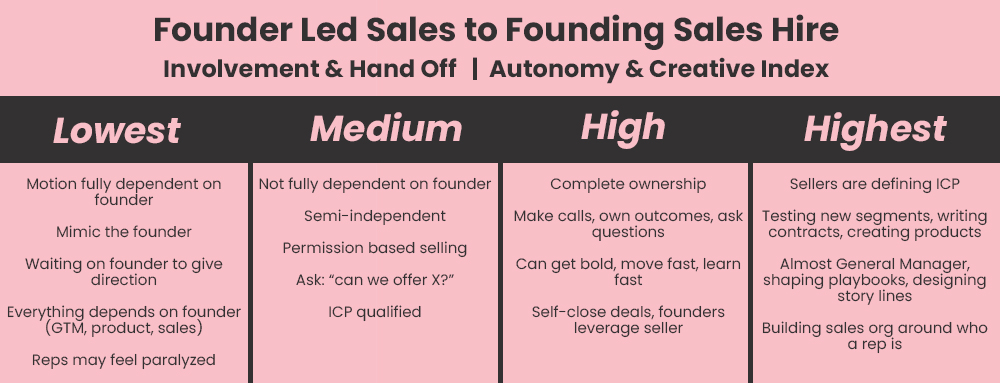
Building your org chart


Hiring decision making

Hiring Decision Making
GTM sales and startup sales executive hiring

Founders underthink & overthink hiring
Sales recruiting with the right pipeline (niche headhunter intros, proof of performance & personality)
Paired with an intentional interview & decision making process can be simple
1. Can they do the job?
Evidenced by provided anecdones/resume
  • Stories & impact details
  • Examples of proven methodologies
  • Made by the talent docs, sheets + frameworks
  • Proof of performance/dashboards, awards, recordings, shout outs, tax docs, social & on record proof
  • References (ideally public on LinkedIn)
  • Can they give you clear & in depth answers? Important that YOU as an interviewer go deep with them vs expecting any & all context up front - check out Yardstick for more in depth context around how to run a good sales or exec interview based on mutual curiosity, context & science
2. Do they have the credibility to do the job?
Evidenced by them using proper industry terms, giving you (assumed expert) insights you’ve seen to be correct in the chosen job expertise (industry, buyer, stage of org/gtm)

Ideally paired with the #1 above with references who are credible/believable who speak on their past experience working with the person (bosses, buyers, peers)

If (tech) skills req (engineering, finance) some type of testing may make sense

3. Do they have a get shit done attitude?
They may ask for certain things to things up for success - contract terms, budget, support etc (see our suggestions for writing a founding sales employment contract that mitigates risk and is still appealing to scrappy roi hire$)

But do you get the sense through the conversation and personality that they’ll roll up their sleeves and do the work when the time comes? Or do references talk about this about the person?

4. Do you like them?
Don’t need to be friends, but do you like them enough to be white boarding for hours together, on countless zoom calls, some stress

Hire from people you’d buy from & learn from

Important to trust your intuition while also being aware of your conscious and unconscious biases & belief systems. Fear is a big reason companies leave revenue on the table by letting fear prevent them from hiring (risk is NOT hiring imo)
What almost putting my dog down taught me about b2b SaaS sales recruiting


We have every framework you need to put your best foot forward with hiring (FREE - only pay us when you hire one of our proven passive, from your industry rep$/ execs)

  • From financial audits & understanding your margins
  • To building a revenue engine from scratch (founder led Proof of Concept (sales)) that can be scaled and insight converted when our founding account executive takes over

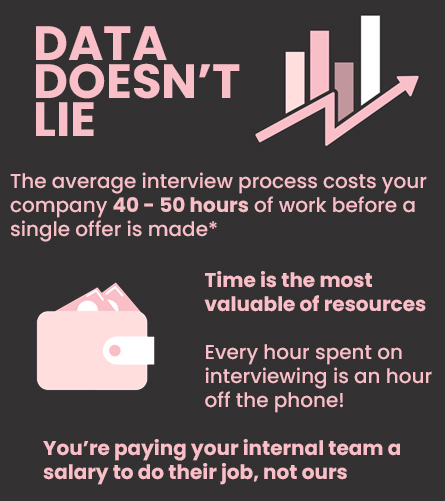
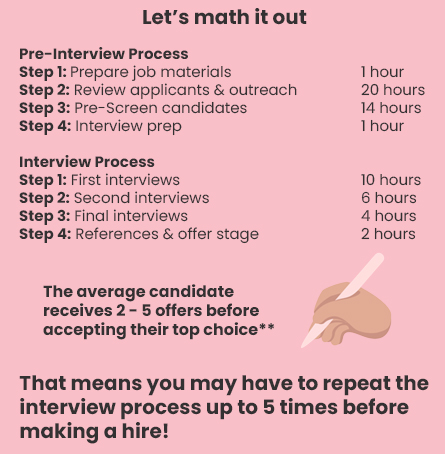
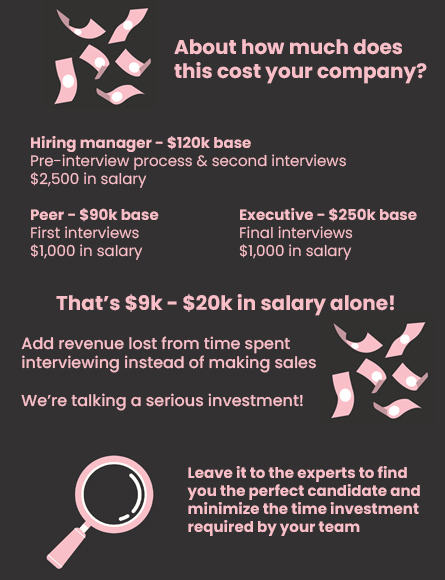
Our time
vs. Yours

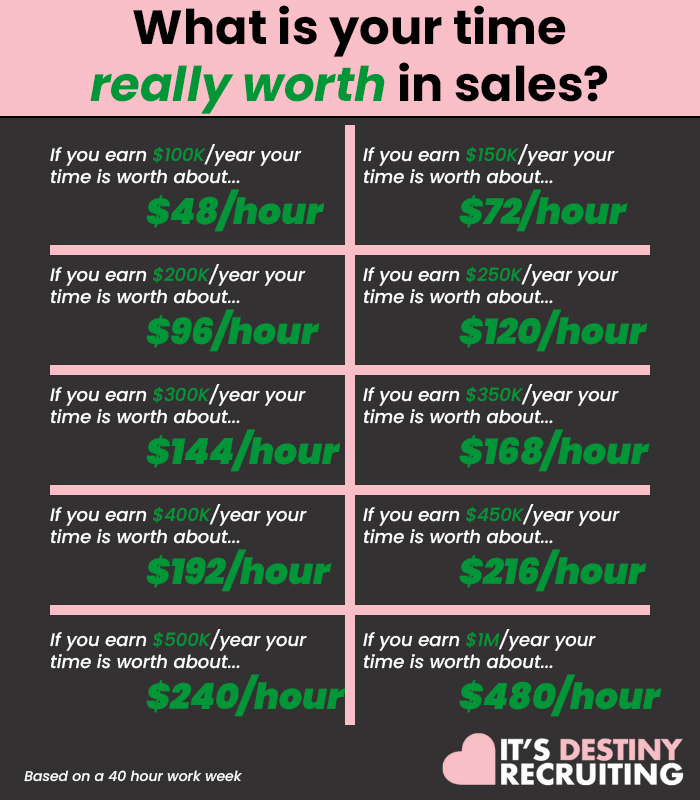
How much is your time really worth?


Ways to win together


Contigent
FREE to interview

The BEST model for founders ready to hire
Proof of concept
Only pay when our candidate has hit a specific milestone within their first 90 days

ATS Vetting
Bring in an expert to spend time looking through and managing your ATS

The client experience

Using video messaging as a major component of our recruiting efforts, we bring the human approach needed to attract passive top performers while being a walking, talking billboard for your brand.

We are not here to replace recruiting efforts, just bring you the best talent as we build relationships with those that exceed quota and are a major culture add. Our job is to make the process inclusive, productive, and transparent for everyone involved so you can focus on making money.

Let's work together


Interested in having an additional set of eyes on the passive seller market?

We talk to 10+ candidates and send you our top referrals.

We're only as good as the reps we can curate for you.